
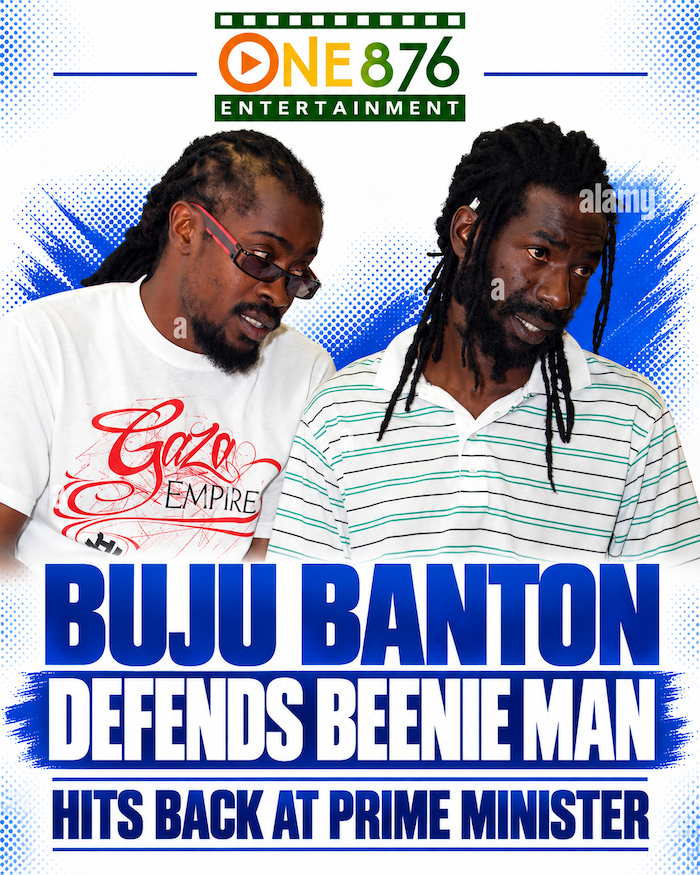
Buju Banton has a message for Jamaica’s prime minister: filling arenas takes more than waving a flag.
The reggae heavyweight jumped to Beenie Man’s defence after Prime Minister Andrew Holness accused entertainers of benefiting from Jamaica’s global appeal while tearing down the country through criticism overseas.
Buju’s response? Jamaican artists have spent decades building the very brand the prime minister says they trade on.
“No you wrong, we do not wave the flag, we are the brand Jamaica, we can’t wave a flag and people attend an event, it takes hard work, credibility, plus a body of work to get people more into Jamaican culture and we have been pushing brand Jamaica long before you enter politics, go check the file,” Buju wrote on social media.
Then came the pointed sign-off: “Big man anno so you do things.”
The clash began after Beenie Man questioned the Government’s handling of Hurricane Melissa relief funds during an interview with Britain’s ITV News. He also raised concerns about coastal development and its potential impact on Jamaicans whose livelihoods depend on beach communities.
Holness responded at the October 28 reopening of reconstructed wards at Black River Hospital in St Elizabeth, a year after the storm. He said more than J$300 million had gone towards repairing the facility and suggested Beenie Man should have been invited to witness the recovery work himself. www.jamaicaobserver.com
The prime minister also accused an entertainer of spreading a false account of Jamaica’s recovery.
“It is a lie that was told on Jamaica by someone who benefits from brand Jamaica and we must call them out because they go and wave our flag and get people to attend their shows while they are out there tearing down the country,” Holness said.
“It is not going to help one more person get one more grant and these things need to be said. Unfortunately I am the only one willing to say it.”
Buju’s intervention challenged that portrayal of the entertainment industry, defending the work and credibility behind Jamaican artists’ international success.
The argument also has a serious financial backdrop. Reporting on an auditor general’s review found that ODPEM had spent J$26.2 million, or 1.8 per cent, of J$1.44 billion in cash donations by February 23, 2026. That finding covered a particular donation fund at that point in time—not all Government spending on hurricane recovery.
A US$150-million loan was allocated to the Jamaica Public Service (JPS) Company Limited for grid restoration, and over $11 billion has been deployed for urgent school repairs across the island.
Out of approximately $1.7 billion in total donations received, $750 million went directly to the Office of Disaster Preparedness and Emergency Management (ODPEM) to fix roofs alongside the Jamaica Defence Force (JDF). Another $800 million has been earmarked for semi-permanent housing initiatives.
International NGOs like Direct Relief have deployed over $41 million in medical supplies and $1.3 million in healthcare grants to back up localized clinics and install climate-resilient power grids
Holness has acknowledged shortcomings while maintaining that the Government’s rebuilding programme deserves greater recognition.
For Buju, however, the dispute reaches beyond recovery figures. His post makes a forceful claim for the standing of Jamaica’s musicians: they have earned their audiences, helped carry the country’s culture worldwide—and have something to say about what happens back home.